
Want to know how to build a stand-out brand? Here are 25+ tips from some of the best branding experts in the biz...


Building a brand from scratch is no easy task. And building a strong, eye-catching brand that stands out from the crowd: well, that’s even more of a challenge. If you’re just starting out on your brand-building journey, you probably have a multitude of questions to answer: What does my brand stand for? How should it look? What’s its tone and personality? Will it resonate with my target audience?
From your core values and business strategy to your competitor landscape and the current branding trends, there are so many points of consideration that go into developing a brand that’s built to last. Whether you’re starting from scratch or looking to revamp an existing brand, we’ve gathered 20 expert branding tips from some of the top experts in the industry to help you create an impactful brand.
Margaret Wolfson, Founder and Chief Creative Officer at River + Wolf

1. Choose an inspired brand name
As the owner of branding agency River + Wolf, I would urge small business owners to let themselves be inspired by the name—not just its letterforms, but its deeper meaning. River + Wolf’s chief design partner, Irasema Rivera, never starts designing until we do a deep dive into the origin of the brand name we’re working with. She asks questions such as:
- What is the thinking behind the name?
- What is it trying to convey or communicate?
- What is its personality?
A year or so ago, we developed the name Anthology for a higher education technology company. The name needed to reflect a merger of three education technology leaders. These three companies were being blended into a single portfolio of technology solutions for universities and colleges.
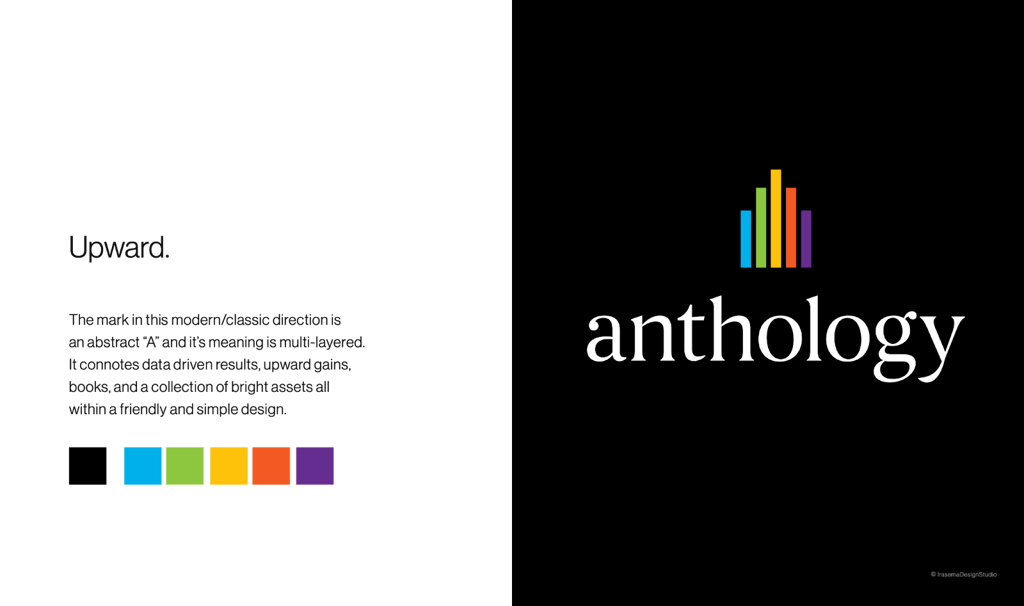
Irasema took all of this into consideration when she developed the logo, which connotes data-driven results, upward gains, and a collection of assets and books. The font is classical, whereas the use of bright colors gives the brand a contemporary, friendly feel. When transforming a name into a logo, you should also avoid treating the name in an overly literal way.
2. Know your core values
Creating a brand is a lengthy process. But the first, and possibly most important step is to identify your core values. In the case of River + Wolf, we’re delivering high-quality personal service, overcoming obstacles with creative approaches, being loyal to our clients, and developing precise and original solutions. We also value simplicity—naming is a complex endeavor made even more challenging by trademark and linguistic issues. Simplifying and clarifying that process for clients is very important.
3. Ensure all touch points connect
If you want to build a strong brand, every touchpoint—from the name, messaging, and copy to the logo, website, and packaging—needs to reflect each other. Unlike visual assets which come and go (think of how Apple’s logo has changed throughout the years), a name has a very long shelf life. So be sure to tie your visual assets to your name. Your name and logo—in fact, all your verbal and visual assets—should be intimately connected.
Tom Abrams, Creative Director at Flowstate Branding

4. Understand your business
Start with a strong and comprehensive understanding of the business or organization you’re working with and the ecosystem it operates within—the company goals, culture, personality, business functions, audience, competitors, market—and build from there. Keep your audience in mind, but don’t feel like you need to pander to them. A strong brand identity will resonate with your audience but can still have its own distinct personality.
5. Keep it simple, memorable, and versatile
Our definition of a good brand, which encompasses everything from logos to messaging to color palettes, is one that’s simple, relevant, memorable, and versatile. When all of those elements are present and working together, a brand can be distinct yet agile. Try to avoid branding trends and what feels cool right now—timeless brands retain their impact and can become even more memorable as time goes on.
6. Know your point of difference
Bronte Cresswell, Director of Dash of Milk Agency
7. Consistency is key
The key to creating a strong brand is consistency! Updating your audience regularly with a consistent content style and core key messages means they’ll be more familiar with you and who you are. One of the worst things that can happen is having your audience confuse you with someone else. People need to be able to recognize your brand design anywhere they see it. You don’t want to put time and effort into generating brand awareness across different online platforms if nobody can recognize you.
8. Trial and error
Building a strong brand and visual identity is really all about trial and error. We started with some fundamentals in terms of colors, graphics, and a style we liked. However, all of that morphed as we developed the business and got into a groove. Our brand really is a reflection of all of our personalities merged together, and that’s the best part because then we’re authentic, and our clients get to feel like they know us. Get more branding tips from Bronte.
Rani Sweis, Creative Director at AtticSalt

9. Design with intent
While eye-catching designs are great, they’re useless without a practical application. Where will your brand be seen? How can you delight customers? To better understand your audience, create a profile of their needs, desires, and consumer habits. Make sure your design helps them achieve their goals and addresses their pain points as quickly as possible.
10. Tell your story
If you study your competition, you’ll better understand what makes you different and be able to articulate your unique personality. Your brand should tell your unique story, each element building off of each other to paint a picture of your offering and point of view.
11. Think thematically
Your logo will rarely be seen on its own with no context. Think thematically, and brainstorm ways to expand on elements of your logo’s look and feel to create a holistic brand system. Not only will this maximize your visual identity’s utility and flexibility, but it will allow you to expand your brand recognition beyond a singular mark.
Kristy Campbell
CEO & Chief Designer at Pink Pony Creative

12. Think differently
My top branding tip would be to try to think outside the box. Do what hasn’t been done before, take what don’t you often see within the industry, and apply that in a way that works well and looks good. Think about what makes YOU or your business different, and use that idea to influence your aesthetic and branding.
13. Tell a story
People love to follow a journey, or a story and get to know the people or meaning behind a business. Get personable, interact and engage. That can be a really key way to help grow a great brand! Good things take time, and the same goes for branding. Your audience will build trust with you over time as they learn your story—don’t expect it to happen overnight. Work hard, keep at it, and your brand will grow. Pick up more branding tips from Kristy.
Boban Vaiagich, Brand Director at Digital Silk

14. Create a brand strategy
Start with a brand strategy. This helps you understand your business proposition and positioning, define your unique brand personality, and analyze your direct competitors to create a brand that stands out. A lot of businesses skip this important step, but it’s key to building a truly competitive and, more importantly, authentic visual brand.
15. Follow a process
The key to creating a brand that will resonate with your target audiences is understanding the business, the target audience, and the competitive landscape.
Here is our typical brand-building process:
- Brand strategy
- Brand identity, persona, and voice
- Logo concepts
- Visual identity
We also create a brand book in which we record the main aspects of the brand strategy, guidelines for logo use, color palettes, typography, iconography, image mood boards, and samples of marketing collateral, such as stationery and social media banners, to bring the brand to life.
16. Start with a clear sense of identity
People tend to feel very strongly about their brand. We often see clients come in with a clear idea of what makes their business unique, who their audience is, and what their brand should look like. You’d think this would make our lives easier as brand designers, but it’s usually easier to guide those without a clear sense of direction. Why? Because data and our analysis don’t always align with the client’s vision, it can be a struggle to reconcile the two. Our advice is to start with a clear sense of identity—this is how authentic brands are born.
Anita Siek, Founder of Wordfetti

17. Create human-centered content
My top branding tip is to create human-centered content, and not just content for the sake of it. With so many brands and businesses out there today, it’s going to take time for your audience to see who you are, what you do, and—why you? BUT, if you stay consistent and show up, your audience and your community will start to build.
18. Consider copywriting & verbal messaging
I’m deeply passionate about helping brands—be it SMEs or organizations—to see copywriting differently. It’s more than a tick in the box, or just words that sound great together or are search optimized. Words are a tool that blends art and science, which can collectively help a brand stand out in its industry.
A lot of people see “brand” as simply visual, whereas a massive chunk lies in the verbal. What do you sound like? How does your brand stand out from your competitors? What are people saying about you when you’re not in the room? What do you stand for? Once you have your brand’s verbal identity and messaging nailed, everything—be it marketing, design, social media, copy—will come together seamlessly.
Fabian Geyrhalter, Founder of FINIEN

19. Be unique
When it comes to design, don’t become fixated on your competitors. It will only make you look like everyone else. Be yourself and be bold—it’s the only way your visual brand will stand out.
20. Create a brand platform
The key to creating your brand is to create a brand platform first, and at the core of that is brand positioning. This will establish who you are as a brand, what your differentiators are, and what values you want to share with your customers. Only once that is in place should you start thinking about the visual language to support your strategic vision. Creating brand clarity for our clients is at the heart of who we are and what we do, so we took that as our driving force when creating our visual language—which is simple and striking, using only one color and font.
21. Focus on the why
I advise those starting out to focus on the “why” and the “how” more than the “what” of your brand. Brands are not all about features and functions, but more about making an emotional connection with customers. Your job is to translate that through a unique design.
Sheree Rubinstein, Founder of One Roof

22. Be persistent
Persistence counts for everything. Starting a brand is hard. Pursuing your passion is hard. Taking risks is hard. Stepping out of your comfort zone is hard. The one thing that makes a person truly successful is their ability to persist and never give up. Of course, there will be times when things aren’t working and you need to pivot or change—or even close one business and open another—but persistence will hold you in good stead.
Underneath it all, if you truly understand your passion and motivation, this will keep you going. Particularly on the days when you just don’t want to get out of bed or when you’re absolutely ready to give up.
23. Use social media to connect
We find a lot of consumers go to Instagram to do a “credit check”, essentially to make sure we’re the right fit. Knowing this, we use it to create a feeling so that when our followers see or read our content we’re making sure to provide value, connection, community, and support. Those are key things consumers look for. If they can experience it on our Instagram, they automatically connect with our brand.
Instagram is just one of our brand touchpoints. We then also use it to cross-promote our overall business activity such as event promotions, blog releases, member profiles, and so on. It’s almost like you’re part of the One Roof community just by following us.
Gianluca Ferruggia, General Manager of DesignRush

24. Research your competitors & market
There are lots of things that freelancers and small business owners need to be aware of when tackling their visual branding. First, you need to explore your competitors: who they are, what they do, and how they perform with their current branding in place. How does their audience perceive them? Are they following the latest trends and best practices?
You then need to accurately define your target audience and buyer persona segments. This includes demographics and psychographic data like age and gender, but also their buying behavior, expectations, profession, etc. All of this informs the direction that your branding will take.
At this point, it’s a good idea to source some inspiration from other designers working in your industry. Check out their Behance, Dribbble, and other online portfolios to get a feel of what is current in visual branding and what speaks to today’s consumers.
If all of this seems overwhelming for new and small businesses, reaching out to branding agencies via DesignRush is a great way to have professionals apply their expertise and set you on the right path.


25. Develop brand guidelines
Once your visual identity is locked in, you need to develop brand guidelines or a brand book covering the brand strategy and the rationale behind the logo concept. Cover the essential DOs and DONTs of the logo design and use of color. Other parts of a brand book include typography, graphic elements such as iconography, illustrations, patterns, and backgrounds, photography (to establish the look and feel of the brand), and collateral images or product mockups where your logo comes to life.
Once the logo and brand book are finished, work on developing designs for online and offline environments. Seek to create a brand identity that adequately represents your product and brand personality. This is a foolproof way to ensure your brand finds its place in a saturated market.
26. Invest in a solid foundation
This is a piece of advice we give to everyone at the beginning of their branding journey: spend time setting up the foundations of your digital product and defining your brand guidelines, including libraries of UI patterns and other reusable components. It will make your workflow much easier, and you will be able to focus on structure, UX, and building a scalable product.
For your digital platforms, UX design is everything. Pay extreme attention to the usability of your design: how intuitive, easy and enjoyable it is for the users.
David Gilliand, Creative Director of Ruckus Marketing

27. Keep evolving
The initial creation of our brand came from a passion and idea. That passion and idea led to a few trips to the library where countless hours were spent going through books and collecting inspiration. From there, Ruckus was born.
Over the years, our brand has continually evolved and is now evolving again. This allows us to stay relevant, to know our strengths and weaknesses, to be true to our clients, and most importantly true to ourselves. It’s important to regularly evaluate your branding: your primary colors, secondary or supporting colors, typography, messaging, graphics, marketing materials, and your company website. All these elements create the face of your brand, and each has an impact and dictates how your brand will be perceived.
28. Build a strong team & skillset
It’s important to be true to yourself and build a team of people who hold the same values. You won’t get too far without a great team alongside you. You also have to know your worth and understand your boundaries. Establish your strengths and become an expert in that area, but also admit or recognize what you’re not good at. It’s okay to not be good at everything, but be honest about it and continue to work on those areas until you become proficient in them.
Nora Inveiss, Brand Manager of Printful

29. Craft a distinct brand identity
A brand identity is made up of the visual elements, name, personality, values, and communication style that represent your brand across advertising, content, promotions, and customer interactions. It’s everything that helps set your brand apart in the market. For example, Printful demonstrates how a strong commitment to quality, sustainability, and design can create a cohesive and impactful brand identity.
When shaping your brand identity, revisit your buyer persona. Consider how they communicate, their appearance, and their behavior, then reflect those traits in your brand’s visuals and messaging.
Your brand’s visual identity includes the color scheme, typography, imagery, shapes, and other design elements that appear in your products and marketing materials.
30. Develop a compelling brand story and personality
Your brand story is the narrative that captures the essence of your business—its origins, purpose, and evolution. Whether it’s your personal journey as a founder or a shared mission, a well-crafted brand story humanizes your business, making it easier for customers to form emotional connections with it.
People are naturally drawn to stories because they’re engaging and often carry a deeper meaning. Creating a brand story and personality will make your business more memorable and relatable.
As you write your brand story, reflect on your core values, mission, and target audience. Consider these questions to guide the process:
- What aspects of your story will resonate with your audience?
- How can you make a personal connection through your story?
- How can you seamlessly weave your brand’s values and mission into the narrative to signal, “This brand is for you”?
Position your buyer persona as the protagonist and your product or service as the solution to their challenges. Illustrate what their experience might look like without your solution, ensuring your story speaks directly to their needs, goals, and aspirations.
Build a standout brand with Envato

And there you have it! The top 25+ branding tips for building a successful visual brand language from some of the top experts in the industry. If you want to brush up on more tools, tips, and trends, check out these articles on How to Start a Small Business or 15+ Expert Tips For Building a Strong Social Media Presence.
Craft a bold, authentic brand with Envato’s professional design tools and templates. From logos to cohesive visuals, our platform simplifies your branding journey, helping you define your identity and connect with your audience. Start creating a memorable brand today at Envato!


